
look back on coperni’s most iconic moments
Coperni, the Paris fashion label that once sprayed a dress directly onto Bella Hadid in front of a live audience, has ceased operations. Founded by Sébastien Meyer and Arnaud Vaillant, the label spent the past few years turning some radical ideas into wearable objects.
Robot dogs walked alongside models, handbags were made from materials developed for space research, and a leather jacket became a functioning sound system. Much of this work involved collaborations with scientists and engineers, which brought onto the runway technologies rarely associated with fashion.
The news of Coperni’s closure, announced on November 4th, 2026, follows a dispute with its distributor and majority shareholder, Tomorrow. While the label’s future has come to an end, its experiments offer plenty worth revisiting. From liquid textiles that solidify on the body to clothing designed to interact with the skin’s microbiome, we look back at eight moments that made Coperni one of fashion’s most curious creative voices.

the spray-on dress that became a phenomenon
There can be no room for doubt: one of Coperni’s most recognizable moments came during its spring/summer 2023 show in Paris, when Bella Hadid stepped onto the runway to have a white dress sprayed directly onto her body. Developed with Fabrican, a material technology company founded by Spanish designer and scientist Manel Torres, the liquid contained fibers suspended in a solution that solidified into a flexible textile as it dried.
The process took place in front of the audience, with technicians gradually building the garment before a designer adjusted its neckline and cut a slit into the skirt. Within minutes, Hadid walked away wearing a fully formed dress.
Coperni Spring/Summer 23 Show | video via Coperni
robot dogs join the runway
For its fall/winter 2023 presentation, Coperni brought five Boston Dynamics Spot robots onto the runway to interact with models. Inspired by Jean de La Fontaine’s fable The Wolf and the Lamb, the performance imagined a possible relationship between humans and intelligent machines.
One robot gently removed a model’s jacket before returning it, while another briefly held onto Lila Moss’s handbag. The four-legged machines moved among the models and even approached the front row, turning the runway into an unusual encounter between fashion and robotics.
Coperni Fall/Winter 2023 Show | video via Coperni
the handbag made with nasa from 99% air
For its fall/winter 2024 show, Coperni unveiled perhaps its most unusual material experiment: the Air Swipe Bag, developed with artist and researcher Ioannis Michaloudis. The translucent object was made from silica aerogel, an extremely lightweight solid consisting of approximately 99% air by volume and 1% glass-like material.
Associated with NASA’s research into capturing cosmic dust, aerogel gave the bag its pale, cloudlike appearance. Weighing around 33 grams, the sculptural accessory retained the recognizable Swipe silhouette despite its extraordinary material composition.
Air Swipe Bag by Coperni, made from 99% Air and 1% Glass | video via Coperni
a handbag that doubles as a CD player
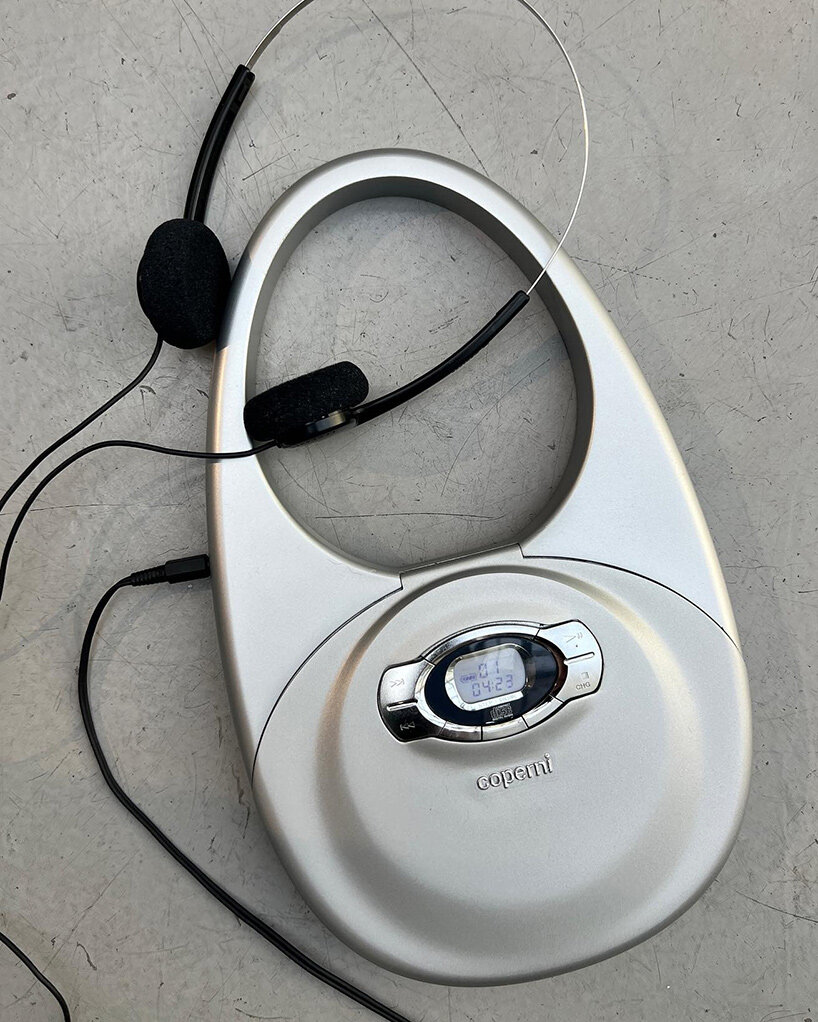
The same collection introduced a different kind of wearable audio device: a 3D-printed handbag that doubled as a portable CD player. Based on Coperni’s curved Swipe silhouette, the metallic accessory accommodated a functioning disc player with wired headphones and a rechargeable battery.
Its appearance recalled the portable music devices of the 1990s, giving a familiar piece of consumer technology an unexpected second life as a fashion accessory.
an ariel-inspired handbag printed inside a bath of gel
For its spring/summer 2025 collection at Disneyland Paris, Coperni turned to an entirely different manufacturing process. Created with MIT spinout Rapid Liquid Print, the Ariel Swipe Bag was formed by extruding blue silicone into a bath of water-based gel.
The gel supported the material as a robotic nozzle drew the bag’s curved form, allowing the flexible object to take shape without conventional printed supports. Named after Disney’s mermaid character, the finished bag emerged from the gel with a soft, continuous surface.
Ariel Swipe Bag, Spring/Summer 2025 | video via Coperni
the tamagotchi returns
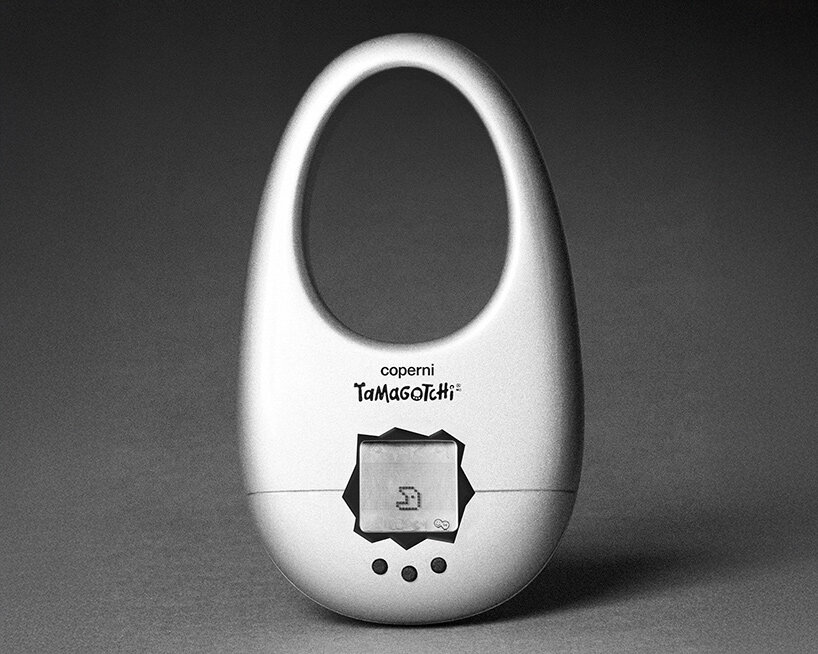
Coperni continued exploring the relationship between fashion and consumer technology in 2025 with its Tamagotchi Swipe Case, developed in collaboration with Japanese toy company Bandai. The miniature accessory adapted the brand’s recognizable handbag silhouette to accommodate a functioning digital pet, reviving the pocket-sized electronic toy that became popular in the late 1990s.
It arrived alongside Coperni’s fall/winter 2025 show, which took place inside a large-scale LAN party at Paris’s Adidas Arena, where hundreds of gamers played at computer stations while models moved between them.
a leather jacket is a working sound system
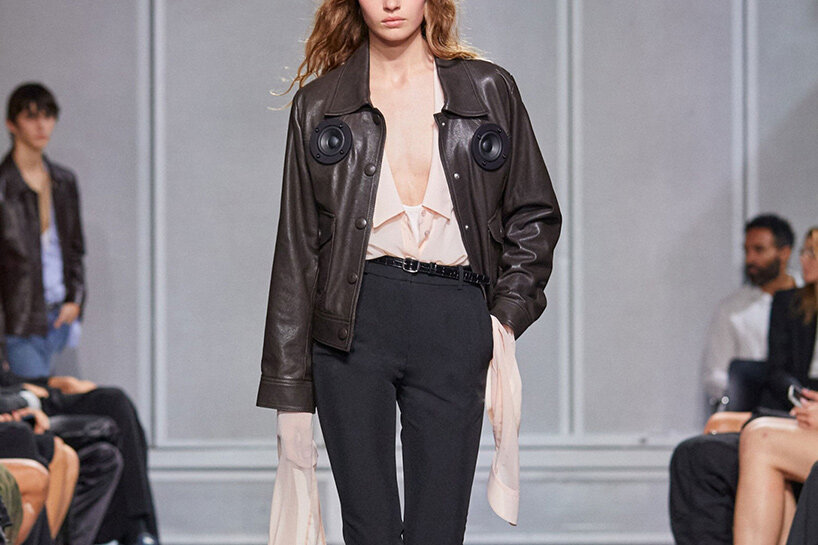
Sound became a central theme of Coperni’s spring/summer 2024 collection, presented at IRCAM, the music and acoustics research institute in Paris. Working with Swedish audio company Transparent, the designers developed a leather jacket fitted with functioning speakers across its chest.
The engineering is surprisingly involved. Custom cavities were shaped to accommodate the audio components, with concealed wiring leading to an amplifier and battery pack stored in the jacket’s pockets. The finished garment allowed its wearer to carry a working sound system directly on the body.
clothing infused with living microorganisms
One of the label’s final experiments moved into biotechnology. Released in October 2025, the C+ collection introduced close-fitting garments treated with probiotics and prebiotics, developed in collaboration with Swiss textile company HeiQ.
The fabric incorporates a bio-based matrix designed to release beneficial microorganisms through contact with the skin, activated by body heat and movement. The collection included leggings and bodysuits intended to support the skin’s microbiome during wear. It offered a different direction for Coperni’s interest in experimental design, imagining clothing as an active material that could interact with the body long after it left the runway.