norman foster brings his architectural thinking to the wrist
Norman Foster unveils his first wristwatch, developed in collaboration with Swiss watchmaker LEBOND and the Norman Foster Foundation’s Innovation and Design Unit. The LEBOND Norman Foster applies the architect’s approach to materials, engineering, and function to a precision timepiece, rethinking the relationship between case and strap through an integrated design that prioritizes comfort and customization. For Foster, the shift in scale does not demand a different design philosophy. ‘I have never really thought that scale changes the nature of design,’ he tells designboom. ‘Whether it is a city, a building, a chair or a watch, you are still asking the same questions: how does it work, how is it made and how do all the parts come together?’ The watch offers an opportunity to apply these questions to an object encountered at close range and used repeatedly throughout the day. Unlike a building, it travels with its wearer, moving between professional settings, journeys, and private moments. ‘What is different about a watch is that it is intensely personal,’ Foster says. ‘You wear it, you travel with it and it becomes part of your everyday life.’
removing the boundary between case and strap
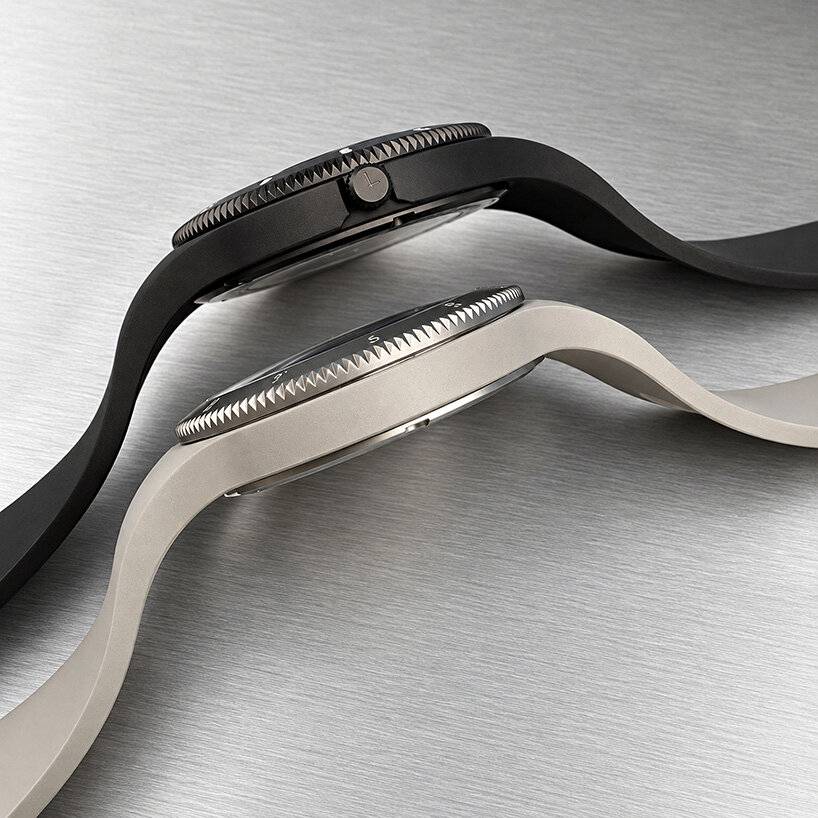
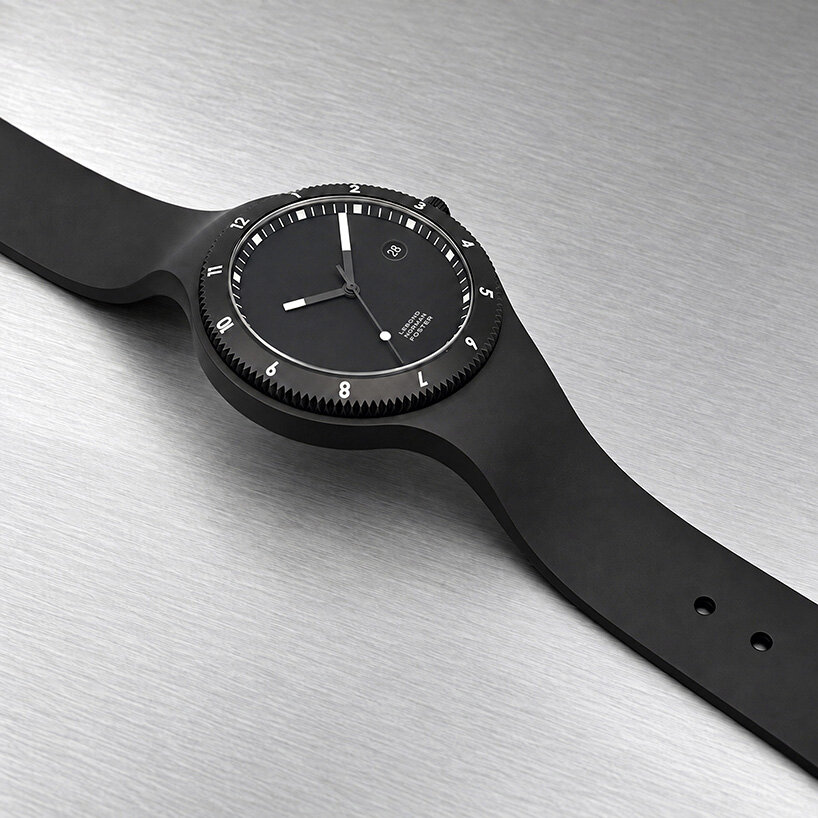
The defining decision is the removal of conventional lugs, the components that typically connect a watch case to its strap. Instead, the strap continues the line of the case, giving the watch a unified profile and allowing it to sit more comfortably on the wrist. The interchangeable strap also allows for different combinations of color and material, giving the wearer room to personalize the watch. ‘Normally, you have a watch case and then you attach a strap to it,’ Foster explains. ‘We started to question the obvious. Why should they feel like two separate objects? Once we began thinking of the strap as a continuation of the case, the whole watch started to come together.’ The decision reflects Foster’s approach to design, in which form and function develop together. ‘For me, it always starts with performance,’ he says. ‘I do not really see form, structure, materials and engineering as separate things. The best designs are those where they all reinforce one another.’ The watch takes shape through a process of sketches, prototypes, and successive adjustments, familiar to Foster from his architectural practice. Each stage brings the design closer to its essential idea. ‘You explore options to finally arrive at the essential idea and then you keep refining it until everything seems inevitable,’ the architect observes.
a precision instrument shaped by travel
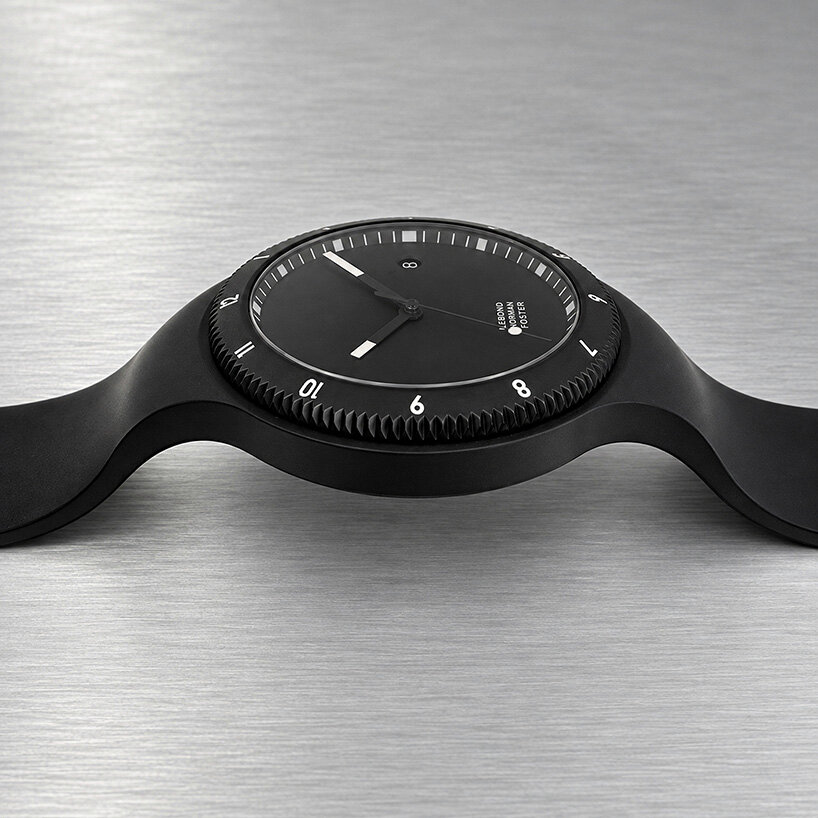
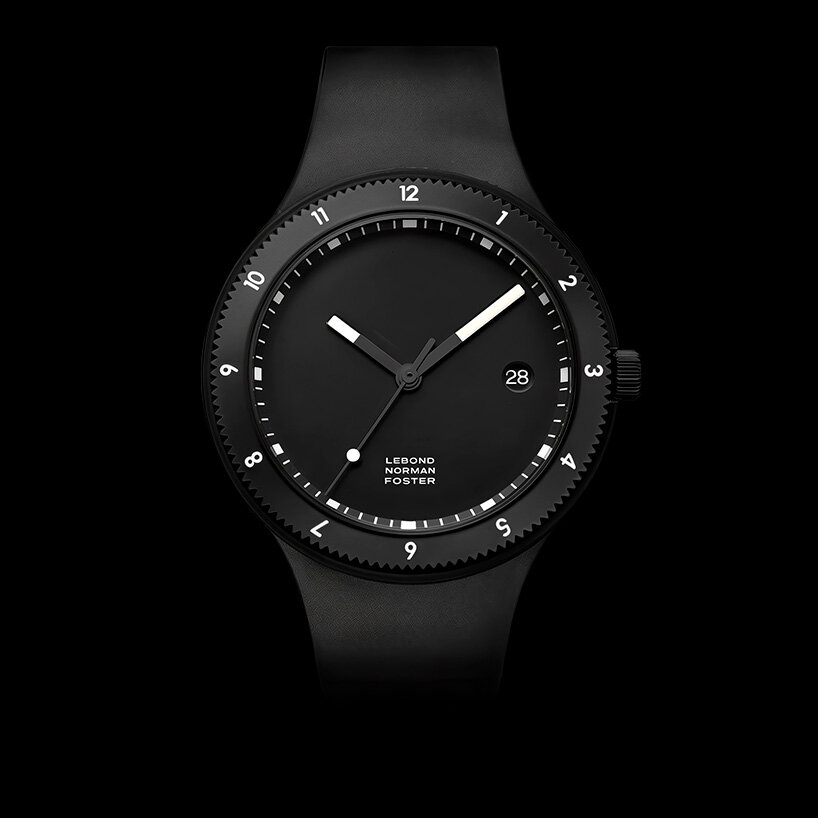
The practical character of the watch reflects Foster’s longstanding interest in aviation and his experience of international travel. Its bidirectional rotating 12-hour bezel allows the wearer to read a second time zone using the main hour hand, addressing a familiar requirement for those who move frequently between locations. The dial follows the same emphasis on legibility. Restrained typography, clearly defined hands with Super-LumiNova, and a date window keep the information accessible without introducing unnecessary visual elements. ‘A watch has to tell the time clearly, it has to be comfortable and it has to work reliably,’ Norman Foster highlights. ‘The rotating 12-hour bezel, for example, comes directly from travelling and the practical need to read another time zone. The dial is deliberately restrained because the information should be immediate and clear.’ This emphasis on use also informs his understanding of timelessness. In a market where watches can function as status symbols and expressions of changing tastes, Foster frames longevity as a consequence of resolving the fundamentals. ‘I think timelessness is really the opposite of fashion. Fashion is transient. A well-designed object should continue to give satisfaction over time,’ he adds.
The case measures 38.5 mm in diameter, widening to 40 mm where it meets the integrated strap, and is 10 mm thick. Made from Grade 5 titanium, it is available with either a micro-sandblasted natural finish or a matte black diamond-like carbon (DLC) coating. Both editions feature a domed sapphire crystal with anti-reflective coating and water resistance to 50 meters. The Natural Titanium Edition pairs its case with a sunray-brushed dial, polished hands, and a light gray FKM rubber strap. The Black Edition combines a matte black-coated case with a black lacquered dial and hands, matched with a black FKM rubber strap. Both use a Grade 5 titanium deployant clasp. For Foster, these specifications matter insofar as they support the intended use of the timepiece. ‘For me, that comes down to purpose, proportion, materials and clarity,’ he points out. ‘If you resolve those fundamentals properly, then hopefully the object can age well. I would much rather it felt timeless than fashionable.’
making the mechanics part of the design
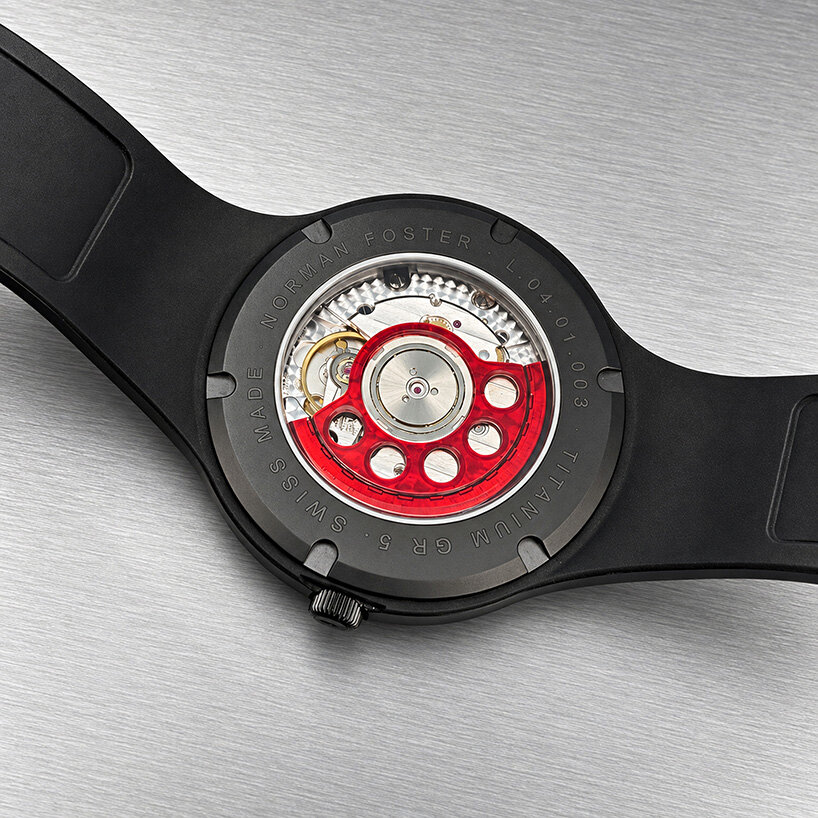
The mechanical movement of the watch introduces another dimension to Foster’s interest in the relationship between engineering and appearance. Through the sapphire caseback, a customized rotor, finished in blue in the Natural Titanium Edition and red in the Black Edition, becomes visible within the automatic movement. Five precision-machined perforations give the component a distinct geometry, while its color introduces a concentrated accent into the otherwise restrained design.
Inside, the watch uses a Swiss automatic ETA 2892-A2 movement operating at 28,800 vibrations per hour, with 21 jewels and an approximately 50-hour power reserve. Each timepiece is individually numbered. The rotor is more than a technical component presented for inspection. Its treatment brings the movement into the overall visual composition, making the mechanism part of the identity of the object. This reflects that engineering need not be concealed to achieve visual refinement, a principle Foster has applied across his work. ‘I have always believed that engineering can be beautiful when you allow the logic of how something works to be visible,’ he reflects.
a watch for everyday life
The collaboration also extends the work of the Norman Foster Foundation beyond buildings and urban research. Through its Innovation and Design Unit, the foundation explores projects across different scales. The project has an educational dimension, too. All proceeds received by the Norman Foster Foundation through royalties from watch sales support the educational programs of the Norman Foster Institute, which focuses on developing future generations of architects, designers, and urban leaders working toward more sustainable and resilient cities. For Foster, however, the measure of the object remains its ability to function naturally across different contexts. He imagines wearing it while working in the studio, visiting a building site, traveling, or attending a formal occasion. Its design should accommodate these situations without becoming tied to any one of them. ‘Probably that good design should improve everyday life without shouting about itself,’ he says, when asked what idea he hopes people carry with them when wearing the watch.
For Foster, the watch is an extension of the way he approaches design across different scales. Its appeal lies in the details, from the way the strap meets the case to the clarity of the dial and the movement beneath it. These are the elements he hopes the wearer will come to appreciate over time. ‘Hopefully, over time, you appreciate the relationship between all the parts rather than one feature in isolation, the way it feels on the wrist, the clarity of the dial, the space it defines, the engineering and the materials,’ Foster says. ‘For me, that is when an object really succeeds: when it simply becomes part of your life and you continue to appreciate it through use.’