
Spoiler alert! We are about to delve into what Digger spends its first half hour hiding – if you have not seen the film yet, save this piece for afterwards.
A CLOSER LOOK AT THE SCENOGRAPHY in ALEJANDRO G. IÑÁRRITU’S DIGGER
About thirty minutes into Alejandro González Iñárritu’s Digger, a model tree falls over, a section of what had looked like a hillside opens up, and a giant man steps out to pick it up while the rest of the crew floods the frame behind him. The director starts shouting instructions, Tom Cruise drops the Texas accent, and everything you have watched so far turns out to have been a technical rehearsal for the 25th anniversary of a stage play called Fossil Fools.
Cruise has been playing Curtis Markson, an actor cast as the oil baron Digger Rockwell in a play about the massive global environmental and climate catastrophe that Rockwell, the most powerful man in the world, has caused: a Greenland drilling operation that releases an enormous ice shelf toward Europe and drowns the coastlines of the world.

It is a plot twist, and a designer’s one, because it first arrives not in dialogue but as a stage technician walking into the shot to deal with a fallen tree. That is the first of four positions the film puts its audience in, each one first arranged by the scenery rather than announced by a character: a mansion that holds the disaster at a safe distance, a play with an audience sitting in front of it, a play that turns out to be a reconstruction of something real, and finally no distance at all. The sets are not a structural game but a measuring instrument for the distance between spectator and spectacle, and across two hours they shorten that distance to nothing.
SET DESIGN AS A STORYTELLING DEVICE
Digger’s world was built by production designers Dennis Gassner and Richard Johnson. Gassner, nominated seven times for the Academy Award for Best Production Design and a winner once, for Bugsy, has a filmography that runs through Barton Fink, Road to Perdition, Blade Runner 2049 and the Craig-era Bond films among many others. The credit that matters most here, though, is The Truman Show, where he built a town that turns out to be a set. The difference in Digger is who is kept in the dark. Truman does not know he is living inside a set while the audience is told in the opening minutes, and Digger reverses that completely, since every actor on screen knows exactly where they are standing and we are the ones who have not yet been told.
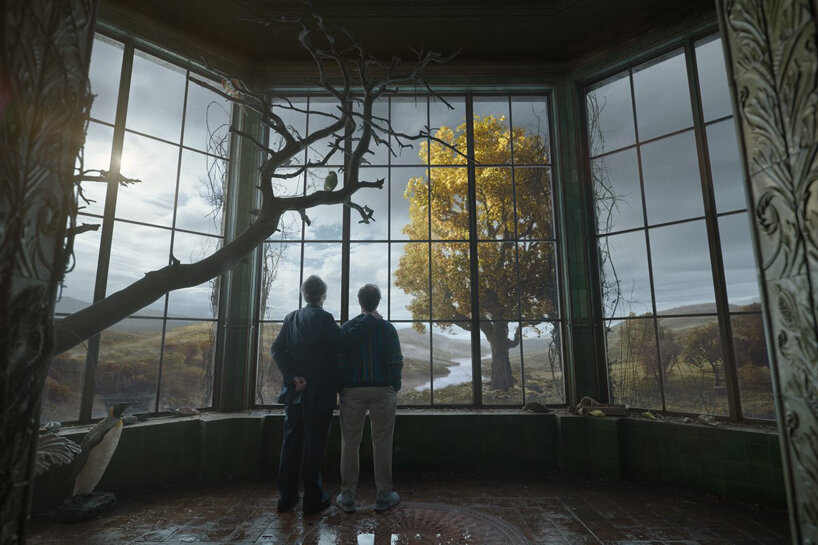
That first world is Digger Rockwell’s lavish mansion, where he wakes beside a bedroom window framing a view that could have been painted by Albert Bierstadt, where taxidermied alligators are pinned to the ceiling, and where full-body mirrors lined with antlers repeat him into infinity. Everything in that house builds the portrait of a monstrous man, and of a monstrousness a long way from your own life. It is the oldest arrangement cinema has: a villain in his lair, a disaster he has caused unfolding somewhere cold, and a fourth wall holding the whole thing at arm’s length. The design here is doing what spectacle has always done, making a catastrophe watchable by placing it somewhere else.
COLOR PALETTE AND PROPS REINFORCE THE NARRATIVE
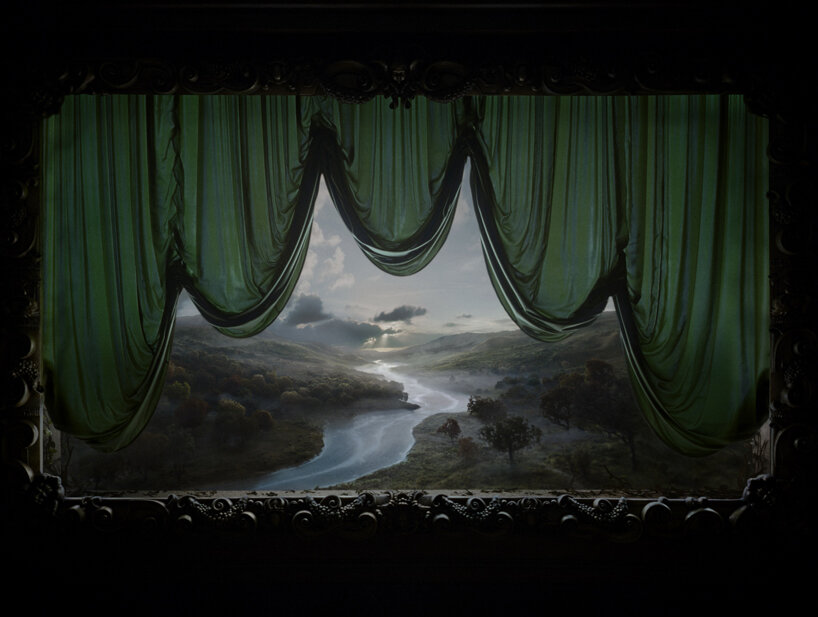
Then the tree falls over, and for a few minutes the film hands you an alibi. Once you know you have been watching a stage production, the artifice of the previous half hour stops being a flaw and becomes a signature. Maggie, Digger’s one-eyed geriatric cat, is a conspicuously obvious animatronic in a film with the money to make a cat look like a cat. Miniatures appear with their seams showing, and clouds and aircraft cross the sky on sticks. None of it was careless, because all of it was intentionally designed.

The palette is running the same argument, and, speaking to Dazed, Iñárritu explains where it comes from. He names Vermeer and the Danish painter Vilhelm Hammershøi for color, with Hopper and Rembrandt for contrast. Hammershøi is the one you can clearly see on screen: a career spent on near-empty grey interiors, two or three notes of color permitted and never more, doorways opening onto further doorways. Iñárritu describes that grey as an instrument rather than a mood, saying that as Digger takes over the narrative, the color is vanishing. So the play looks drained and the backstage looks alive, and the contrast is reassuring in a way that is almost physical. Grey is where the fiction lives, color is where reality is, and reality appears to be holding.