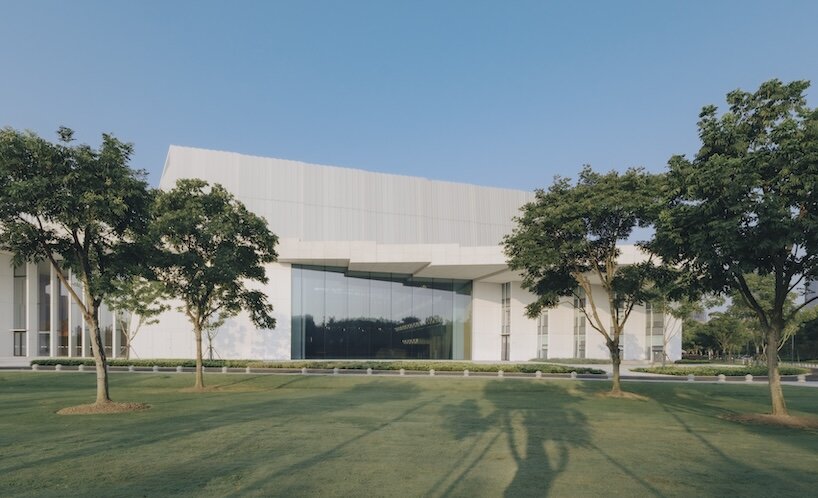
SNØHETTA’S SHANGHAI GRAND OPERA HOUSE OPENS ON HUANGPU RIVER
After nearly a decade in the making, Snøhetta’s Shanghai Grand Opera House officially opens on October 17, 2026, bringing a new cultural landmark to the banks of the Huangpu River. Spanning 146,786 square meters, the completed building houses three auditoriums with a combined capacity of 4,200 seats, alongside rehearsal, production, education, exhibition, and hospitality facilities. Yet the Norwegian architecture studio’s ambitions extend beyond creating a world-class performance venue. Conceived as an accessible public destination, the Opera House invites residents and visitors to experience its architecture and surrounding landscape, whether or not they have a ticket.
The project follows Snøhetta’s winning proposal in the 2016 international competition and was developed in collaboration with East China Architectural Design & Research Institute (ECADI), Theatre Projects, and Nagata Acoustics, formally commissioned as a consortium in 2019. Designed to accommodate everything from traditional opera and classical music to experimental productions, the venue brings together the technical demands of a major cultural institution with a decidedly more open approach to public space. Its inaugural season, running through February 20, 2027, will feature 82 performances across 47 productions.
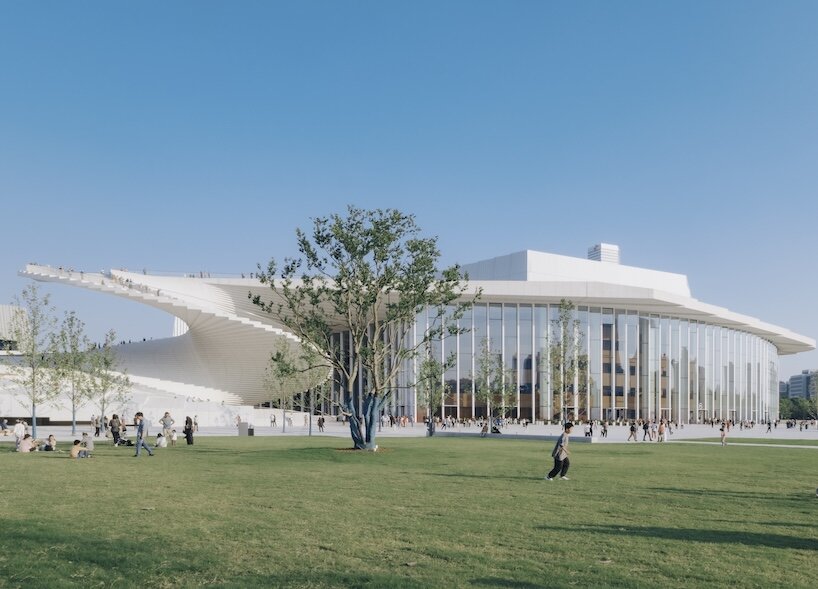
A SPIRALING ROOFTOP CONNECTS THE OPERA HOUSE TO SHANGHAI
The building’s defining architectural gesture is Snøhetta’s sweeping white roof, which rises from the surrounding landscape in a continuous spiral. Inspired by the movement of the Huangpu River and the unfolding geometry of a traditional Chinese fan, the structure creates a fluid connection between the waterfront, the city, and the Opera House itself. A spiraling staircase leads visitors from ground level to the elevated roof, transforming it into an observation deck, informal stage, and year-round gathering space. With panoramic views of Shanghai’s skyline, the rooftop offers perhaps the building’s most democratic feature: an architectural experience that requires no admission ticket.
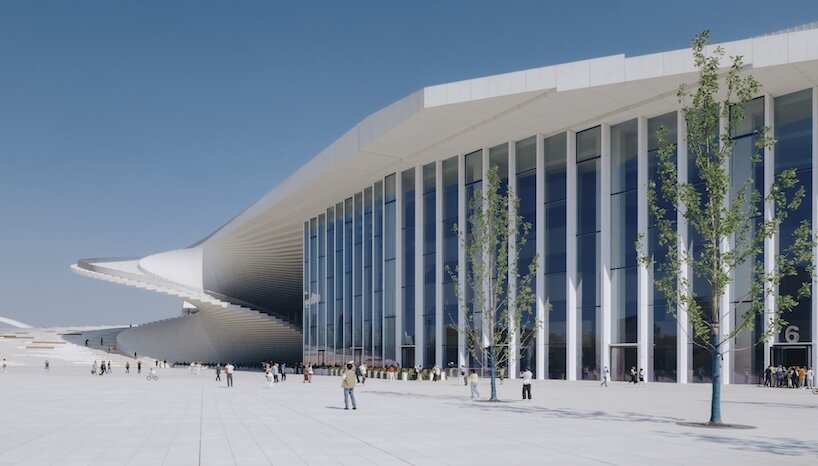
This sense of continuity extends throughout the exterior, where a geometric facade connects different public levels while balancing transparency and enclosure. Expansive glass surfaces introduce natural light into the shared interiors, while exterior lighting transforms the stage towers into luminous volumes after dark. At ground level, the surrounding landscape follows a radial arrangement that extends the building’s geometry into the Expo Houtan district, strengthening connections with the neighboring park and waterfront. Restaurants, exhibition spaces, and educational facilities further integrate the complex into everyday urban life, ensuring that the building remains active beyond its scheduled performances.
THREE AUDITORIUMS BRING 4,200 SEATS TO THE SHANGHAI GRAND OPERA HOUSE
Inside, the architectural language shifts from the predominantly white exterior to a series of richly textured performance spaces. The centerpiece is Harmony Hall, a 2,000-seat auditorium arranged across five levels, with a dramatic dark-red interior conceived to enhance the acoustics of the human voice. Carefully positioned balconies and smaller side boxes help establish a closer relationship between audiences and performers. The 1,200-seat Soar Theatre offers a more intimate setting for classical opera, operetta, regional productions, and theater, while the 1,000-seat Open Stage introduces adaptable seating and stage configurations for experimental performances, complemented by panoramic views toward the surrounding park.
Although the three auditoriums differ in scale, atmosphere, and technical requirements, they share a cohesive architectural identity beneath the spiraling roof. Carefully selected materials, contrasting color palettes, and fluid circulation routes guide visitors through the building, making movement itself part of the experience. Passive design strategies, natural daylight, and landscape integration also contribute to its environmental approach. Ultimately, Snøhetta’s Shanghai Grand Opera House proposes a cultural institution whose public role extends well beyond the performances it hosts. The curtain may rise inside, but the architects have made sure there is plenty happening outside, too.