Straw and earth shape land art installation at La Nave Va
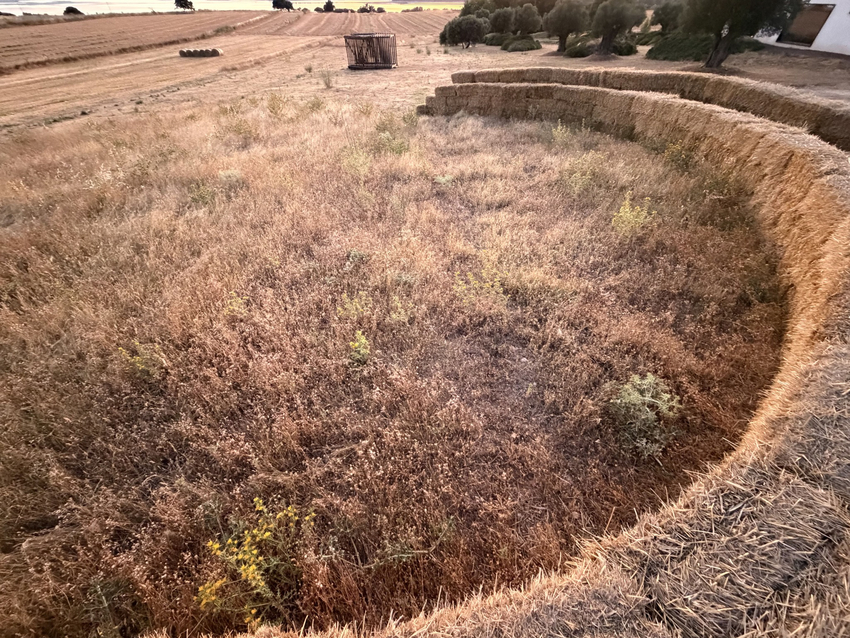
KURA is a land art installation by Paisajeencontrado at La Nave Va, an open-air sculpture park in Berrocalejo, Cáceres, Extremadura, Spain. Built from straw, earth, stones, and native seeds, the project combines an amphitheater, an experimental Mediterranean garden, and a walking path to explore ecological processes and native plant conservation.
Curved straw walls compose KURA living amphitheater
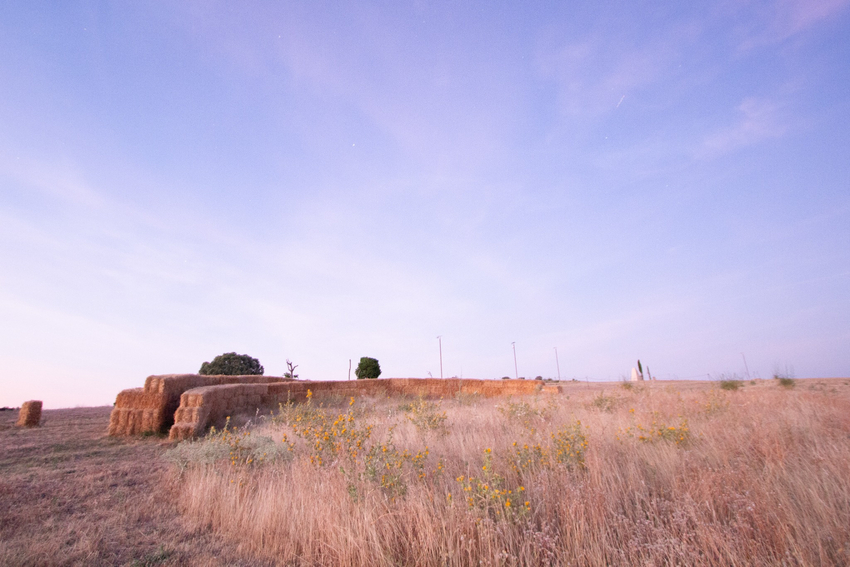
Curated by Andrey Brito, the project brings together Studio Paisajeencontrado, visual artists Kika Goldstein and Kmilo Morales, and landscape architect Ismael Pizarro. Two curved straw walls guide visitors through a narrow passage that gradually opens onto views of a centuries-old olive tree and an old holm oak. The walls also shape a shallow amphitheater along the route. The passage alters the experience of the landscape by softening sound and maintaining a more stable temperature.
The second wall functions as a living structure. During the installation’s inauguration at the spring equinox, participants sowed native wildflowers and grassland species, including Centaurea cyanus, Papaver rhoeas, and Plantago lanceolata, directly into the straw. The surrounding meadow remains unmowed, allowing vegetation to gradually complete the amphitheater’s semicircular form.
a field for botanical research and native seed conservation
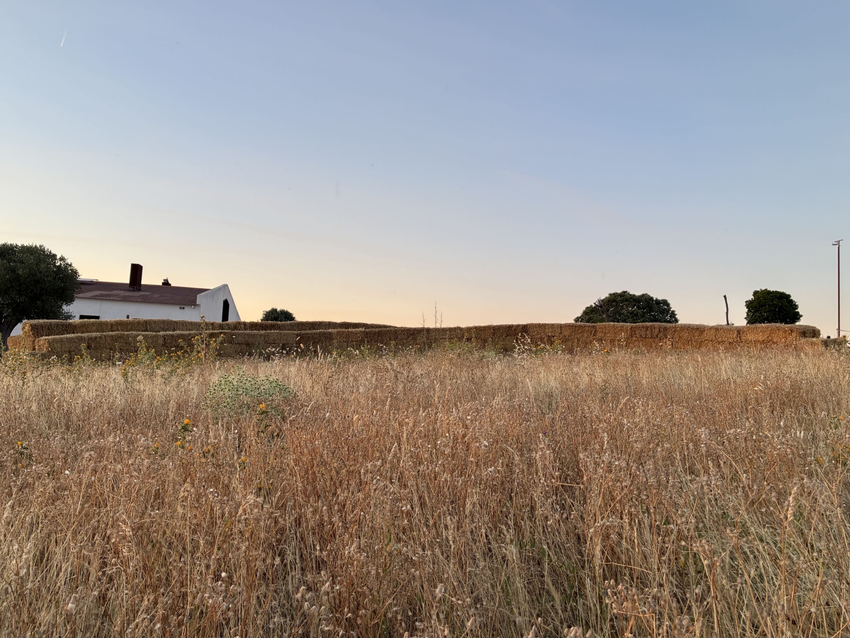
At the center of KURA, an approximately 200-sqm area of natural meadow serves as a site for botanical observation and experimentation. An ongoing program tracks the germination, flowering, and fruiting of Mediterranean grassland species, tests different mowing methods, and collects and propagates native seeds. In collaboration with the Plant Germplasm Bank ‘César Gómez Campo’ at the Polytechnic University of Madrid (BGV-UPM), collected seeds are also stored off-site to support the conservation of wild plant genetic resources and research into Mediterranean flora.
KURA operates as both an artwork and a field of observation, bringing together artists, landscape practitioners, researchers, and local participants. The site accommodates performances, photography, and collective and botanical activities, while its materials and vegetation change with the seasons. Through its spatial arrangement and ongoing ecological program, the installation connects visitors with the landscape’s biodiversity, agricultural cycles, and rural knowledge.